
💰 Money Sense With Nnaoma
"Your Money. Your Power. Your Future."
Successful Nigerian Couple Reveals The Secret Guide That Helps Struggling Married Nigerian Couples Overcome Financial Pressure And Build Lasting Wealth
You and your spouse are both working.
Two incomes. Two salaries. Two people doing their best every single month.
And yet... by the 20th of the month, the money is gone.
You don't even know where it went.
You sit down and try to think — rent? Yes. Feeding? Yes. Transport? Yes. School fees? Yes. Data? Yes. Random emergencies? Always. But still... something is not adding up.
You said this month would be different. You always say that.
You open your phone and check your account balance. The number stares back at you like an insult. You lock the screen quickly before your wife sees it.
"Is it that bad?" a voice whispers inside your head. "We cannot even last to the end of the month. What are we doing wrong?"
At night, you lie beside your wife but the silence between you feels heavy. There was a time when you used to talk freely. Laugh about small things. Plan for the future. Now, money has become the topic nobody wants to start — because when it starts, it always ends in pain.
She said something last Tuesday. A small thing. But it cut deep. "I thought it would be easier by now." She wasn't shouting. She was just... tired. And that tired voice of hers lives in your chest now, heavier than any argument.
Your mother keeps asking when you'll move out of the rented flat. Your father-in-law calls every birthday asking if you've "started anything." Your children are growing. School fees are no longer small. And everywhere you turn, there is a new bill, a new expectation, a new pressure.
"I don't want my children to grow up the way I grew up." You think about that every morning in the bathroom, the one place in the house where you can have thirty seconds of silence.
You are not lazy. You are not careless. You are not a bad husband or a bad wife. You are just... stuck. Working hard but going nowhere. Running fast but the finish line keeps moving.
And the worst part? You cannot even explain it to anyone. Because on the outside, everything looks fine. You dress well. You show up. You manage. But inside the four walls of your home — you know the truth.
Drop everything you are doing now and listen to every word I'm about to say.
"Because I'm about to share with you a simple 30-day system that completely changed the financial story of my marriage — and has already changed the story of hundreds of Nigerian couples just like us."
About This Story
What I am about to share is not a new idea. It is not something invented in Silicon Valley or taught in an American MBA programme. It has been quietly working in Nigerian homes for decades — in the families of people who never shouted about it, never put it on Instagram, never wrote a book about it. They just quietly built wealth. They just quietly raised children who never had to worry about feeding. And when you visited them, you couldn't always explain why their home felt so peaceful while yours felt like a war zone over money.
This method is built on the kind of wisdom our parents should have taught us at the dining table. But they didn't — because nobody taught them either. We were all born into a system that taught us how to work hard but never how to make our money work for us.
The good news? It is not too late. Not for you. Not for your marriage.
My name is Nnaoma. I run this blog — Money Sense With Fybest. First thing you should know about me is that I am not a financial advisor. I am not a certified wealth coach. I am not standing here with a PhD in economics. I am just a Nigerian man who watched my very close friends, Mr & Mrs Tobechukwu, walk through the kind of financial hell that almost destroyed their home — and then watched them find a way out. What they learned changed their lives. And I believe, with everything in me, that it can change yours too.

Their Story — In Their Own Words
"We Were Both Working and Still Going to Bed Hungry. Here Is What We Finally Did About It."
My name is Tobechukwu. My wife's name is Chioma. We are from Ihiala, Anambra State.
And I want to start by saying something that took me years of shame before I could say out loud:
The early years of our marriage were hell.
Not the kind of hell where everything is dramatic and you can point to a single problem. The quiet kind. The kind where you wake up every morning, put on your good shirt, go to work, come back home, and act like everything is fine — while inside, you are drowning.
It started the year our second child was born. Up until that point, we were managing. Things were tight, but we had a kind of rhythm. Then Emeka was born, and suddenly the expenses multiplied. Two children. More food. More everything. And our income stayed exactly the same.
I remember one Thursday evening. I had checked my account three times already. The number was not going to change. We had N1,400 left. Rent was due in nine days. We had garri in the house and some dried fish. That was dinner. That was what we had.
Chioma didn't say anything. She just cooked and served and sat across from me at that small table in our one-room apartment in Aba, and we ate in silence. But her eyes said everything. Is this what I signed up for? I didn't have an answer for her eyes.
The arguments started small. A comment about a purchase. A question about where the money went. An old bill that surfaced at the wrong time. But each small argument left a scar. And the scars started adding up.
There were nights Chioma would turn her back to me in bed and I would lie there staring at the ceiling, thinking: What is wrong with me? I am working. I am trying. Why is this not enough?
I stopped calling my parents as often. I knew what they would ask. "When are you getting a bigger place?" "How are the children?" I couldn't explain that the children were fine but their father wasn't sure he could pay their school fees. So I just... avoided the calls.
The worst moment came on a Sunday afternoon in March. Chioma had gone quiet for two days — not the angry kind of quiet, the resigned kind. She called her sister and I was not supposed to hear. But our apartment was small and the wall was thin.
"I don't know what we are doing, Adanna. Every month is the same thing. Every month. I am tired. I am just so tired."
I sat down on the edge of the bed and I could not move for a long time.
That was my breaking point.
The week after, I called my Uncle Chidi. He is not a wealthy man, but he has a kind of steady peace about him that I always respected. He listened to me for thirty minutes. Then he said something I will never forget:
"Tobe, the problem is not your salary. The problem is that you and your wife have never sat down and looked your money in the face — together. You are both afraid of the number. And whatever you are afraid to face will always control you."
I didn't fully understand what he meant at the time. But those words stayed with me.
I started looking for solutions. I tried everything.
First, I downloaded four budgeting apps. Cowrywise. Piggyvest. Some American app someone recommended online. I set them up carefully, entered all our income and expenses, and felt very proud of myself. By week two, I had stopped using all of them. Because the truth was: the problem was not that I didn't know where the money was going. The problem was that there wasn't enough money to track. A budgeting app doesn't help you when you're already in a hole.
Then I tried side hustles. I started buying and reselling phone accessories on Jiji. Made some small profit for three weeks, then the market flooded and margins died. I tried freelancing — someone told me I could write content online for dollars. Spent two months trying to land clients. Got one. They paid me ₦12,000 for three articles and disappeared. The hustle was real but the results were not sustainable.
We joined an Ajo group in our street — twelve people, ₦5,000 each per month. When our turn came, we got ₦60,000. Felt like a breakthrough. But all it did was pay the rent arrears we were already carrying. Same water, same bucket. Just rotating.
I watched YouTube. Hours and hours of it. Every finance channel I could find. But they were all talking about putting money in index funds, building a Roth IRA, buying ETFs, investing in the S&P 500. None of it applied to a man in Aba whose salary came in naira and who had never had a dollar account. Their problems were not my problems. Their solutions were not my solutions.
I went to a motivational seminar at a church hall on a Saturday. The speaker was sharp. He talked about mindset, about poverty consciousness, about generational curses and breaking them with declaration. I felt powerful for two days. On Monday morning, the bills were still there. The mindset had shifted but the money hadn't.
Nothing was working. And the quiet in our home was getting louder.
---
Then came the day that changed everything. And it came from the most unexpected place.
A friend needed help coordinating a traditional wedding in Enugu. He knew I was free that weekend and asked if I could assist as event coordinator — nothing big, just making sure vendors were on time, guests were seated, that sort of thing. He would pay me ₦15,000 for the day. I said yes. We needed the money.
The wedding was beautiful. Anambra colours, full uli, the kind of celebration that reminds you why our culture is worth preserving. I was running back and forth, managing things, when during the afternoon break I found myself standing near the food tables with nowhere urgent to be.
An older man was standing there too. Calm. Composed. The kind of man who didn't need to announce himself. He was maybe 56, 57 — well-dressed but not showy. His wife stood beside him in a matching outfit, and the way they stood together told you something: they were a team.
He noticed me looking overwhelmed and smiled. "You're coordinating this thing?"
"Yes sir. Still learning."
"You'll be fine. I can see you're the kind of man who doesn't give up."
I don't know why that simple observation opened something in me. But it did. We started talking. His name was Mr Ngoedu. He and his wife, Mrs Ngoedu, had been married for 35 years. They were from Onitsha originally, now lived in Abuja. He had retired from a government ministry at 55 and they lived — comfortably, from what I could see — on pensions and some investments they had built over the years.
I didn't plan to talk about money. But somewhere between the pounded yam and the third glass of juice, I told him the truth. I told him about the apps. The side hustles. The ajo. The YouTube videos. The seminar. I told him that I was working every day and still didn't know how we were going to survive.
He listened without interrupting. His wife listened too. Then Mr Ngoedu looked at me directly and said something I will carry for the rest of my life:
"Young man. Stop running from one solution to the next. You are treating the symptoms, not the disease. The disease is that you and your wife have never, not once, sat down together — calmly, without blame — and looked at the full picture of your money. Not just income. Not just expenses. The whole picture. The debts. The leaks. The habits. The assumptions. You are both managing in the dark. And when you manage in the dark, the money will always disappear. The first thing you must do — before any investment, before any side hustle — is sit down together and face the truth."
I wanted to say "we know our situation." But I stopped myself. Because the truth was — did we really?
Mrs Ngoedu leaned forward and added softly: "When we were young and struggling, my husband and I had one rule. Every month, before we spent anything, we sat together and we wrote everything down. Everything we earned. Everything we owed. Everything we were leaking. Not to judge each other. Just to see. Because you cannot fix what you cannot see."
It sounded almost too simple. Isn't that just budgeting? I almost dismissed it. But there was something about the way they said it — together, finishing each other's thoughts, smiling at the memory — that made me believe them.
Mr Ngoedu gave me a notebook before I left. It had a simple framework in it. A one-page exercise he called a "Money Truth Audit." He walked me through it right there at the wedding. And then he gave me a 30-day structure to follow after that.
I went home that night with the notebook and ₦15,000 in my pocket. I sat across from Chioma after the children slept and I said: "I want us to try one more thing. But this time, let's do it together."
She almost didn't agree. She was tired of "trying things." But something in my tone that night must have been different. She sat down.
We opened the notebook. We started the Money Truth Audit.
Within twenty minutes, we were both staring at the page in silence — but it was a different kind of silence. Not the heavy, resentful silence of two people who have run out of words. It was the silence of two people who had finally seen something clearly for the first time.
We were leaking money in at least five places we had never paid attention to. Not because we were stupid. Because we had never looked. We had been reacting to money our whole marriage instead of directing it.
Chioma looked up at me and said quietly: "Tobe. We've been managing the wrong things."
That was the moment everything shifted.
We followed the 30-day structure faithfully. The first week was uncomfortable — seeing the real numbers was not pleasant. But by the end of week two, we had already plugged three of the leaks. By week three, Chioma started talking to me about money differently. Not as a trigger for arguments — as a project we were working on together. She started making suggestions. I started listening differently. We even started planning — actually planning — for the first time in four years of marriage.
By day 30, we had not become millionaires. I want to be clear about that. But we had done something more important: we had stopped the bleeding. We knew exactly where every naira was going. We had a plan. And for the first time, our home felt like a partnership instead of a battlefield.
Three other couples from that same wedding — people I had briefly spoken with — also took the framework from Mr Ngoedu. I found out months later from my friend who organised the event.
One couple, the Okafor-Ngozis from Awka, had been planning to move to separate apartments. After 21 days on the plan, they reversed that decision. Mrs Okafor-Ngozi told my friend: "We just needed to see the truth together. Once we saw it, we stopped fighting each other and started fighting the problem."
Another couple — I only knew them as Mr & Mrs Eze from Port Harcourt — told him they found ₦47,000 per month in hidden leaks within the first two weeks. Not new money. Not a side hustle. Just money they had been bleeding without knowing it.
A third couple, younger than us — a girl who had just had her first baby, her husband doing gig work — said the Money Truth Conversation Script was what changed everything for them. Before, any discussion about money turned into an argument. With the script, they could finally talk without the temperature rising. She said: "It was like someone gave us a map. We stopped walking in circles."
I heard those stories and I knew I could not keep this to myself.
After that night with Chioma, and after hearing what happened with those other couples, my phone started to fill up with messages. Friends of friends. People who had heard through word of mouth. People asking me to explain the framework, to send them the notebook pages, to walk them through it on a call.
I did my best to help each person individually. But it wasn't scalable. Some people got half the information. Some got confused on step three. Some couples did it alone and missed the partner component entirely and wondered why it wasn't working.
So I did something about it.
I worked with a professional writer. I hired an editor. I tested the full system with fifteen couples over two months, refining every exercise, every script, every tracker — until the guide was clean, clear, and complete.
I put everything inside one simple guide. The full audit. The step-by-step 30-day system. The conversation tools. The templates. Everything you need — tailored specifically for the Nigerian married couple, built around Nigerian cost of living, Nigerian family pressure, and Nigerian financial reality.
Introducing...
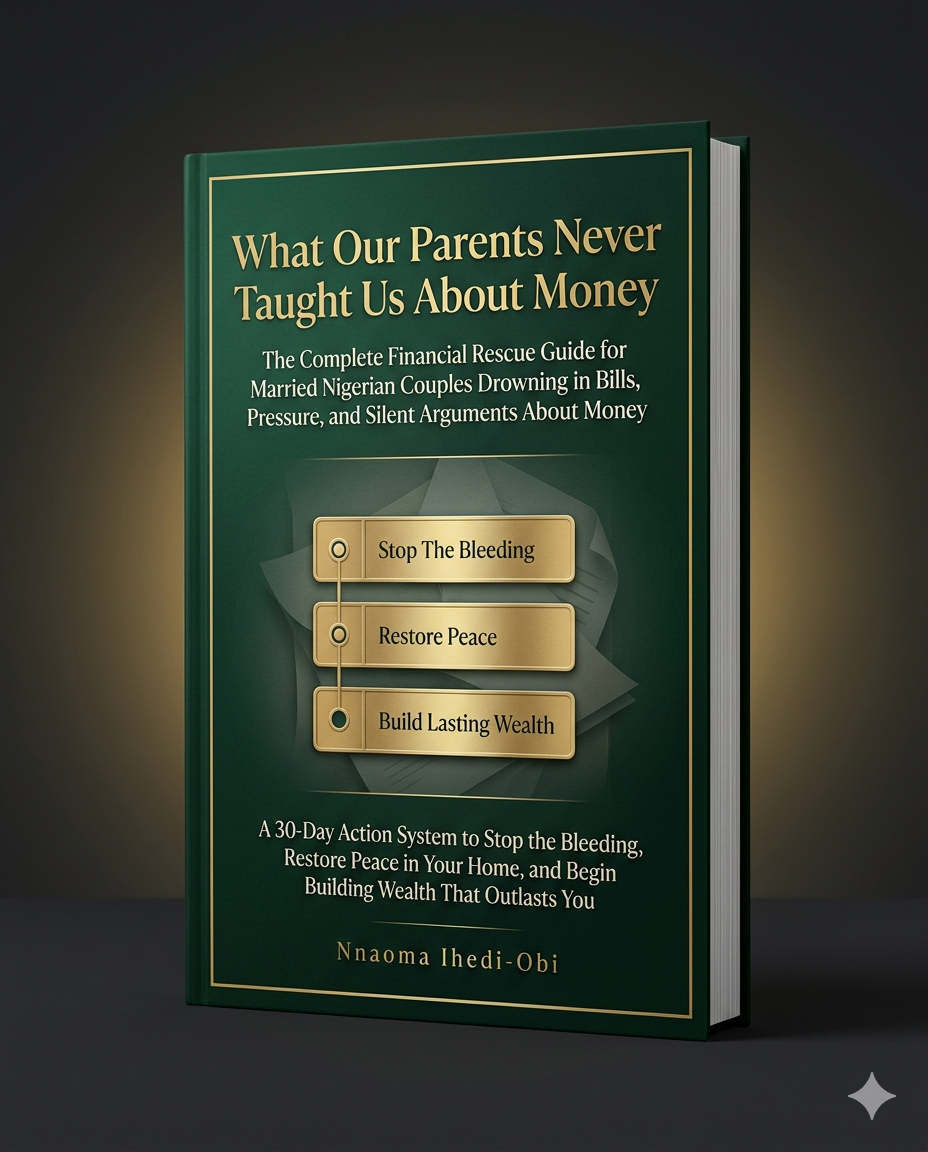
What Our Parents Never Taught Us About Money
The Complete Financial Rescue Guide for Married Nigerian Couples Drowning in Bills, Pressure, and Silent Arguments About Money
A 30-Day Action System to Stop the Bleeding, Restore Peace in Your Home, and Begin Building Wealth That Outlasts You
Inside this e-guide, you'll discover:
(Everything built for Nigerian couples. Nigerian income. Nigerian cost of living. Nigerian reality.)
-
The Couples Financial Audit Sheet — Pg. 4
A complete one-page snapshot of your household income, all expenses, every debt, and — most importantly — the silent leaks you never knew were draining you every month. Most couples who complete this exercise find at least 2-3 leaks within 30 minutes. Not because they are careless. Because they finally looked. -
The Monthly Budget Template (Built for Nigeria) — Pg. 12
Forget the American templates that assume you earn in dollars and invest in ETFs. This template is built around naira income, Lagos/Abuja/Enugu costs, and the real pressure of supporting extended family while trying to build your own home. You can fill this in tonight and wake up tomorrow with a plan that actually fits your life. -
The Money Truth Conversation Script — Pg. 22
The guided script that lets couples talk about money without the conversation turning into a battlefield. Line by line. Question by question. This is the tool that helped Mrs Okafor-Ngozi and her husband reverse a separation decision. It removes the blame. It removes the temperature. And it gets both of you talking as partners — not opponents. -
The 30-Day Action Tracker — Pg. 30
Daily and weekly checkboxes that keep both of you moving and accountable. No guesswork. No "what are we supposed to do this week?" Just clear, simple daily actions that compound over 30 days into a financial foundation you have never had before. -
The "Wealth That Outlasts You" Roadmap — Pg. 38
Once the bleeding stops — what next? This section shows you the first three moves to begin building real, lasting financial stability and generational wealth, using the income you already have. No startup capital. No unrealistic timelines. Just honest, Nigerian-market-tested steps.
And the best part? You do not need to earn a huge salary, or wait for a business to blow, or pretend the pressure from your in-laws doesn't exist. It's the same simple 30-day method that worked for us — and has now worked quietly for over 200+ married Nigerian couples who received early versions of this guide.
💬 Real Couples. Real Results. Real Testimonials.
CB
Chidi & Blessing Okoye
The Money Truth Conversation Script alone is worth ten times the price. My husband and I used to argue every single time money came up. Every time. It would start as a question and end as a war. With this script, we had our first calm money conversation in four years of marriage. FOUR YEARS. He was even surprised himself. He said "Blessing, is this the same woman?" 😂 We are now planning our first family savings target together. I cannot explain the peace in our home. This is not just a finance guide — it is a marriage guide. I am not even joking.
★★★★★
KN
Kelechi Nwachukwu
I thought because we are abroad this wouldn't apply. Wrong. The framework is universal — the Nigerian couple's mindset and pressure doesn't disappear when you cross the border, e. We still had the same family expectations from home, the same monthly panic, the same "where did the money go" conversations. We downloaded this and adapted the budget template to Canadian dollar income. Everything else was 100% applicable. Day 22 now and we have our first emergency fund target in progress. Do not sleep on this guide because you think you're "too sophisticated" for it. We thought so too. We were wrong.
★★★★★
IA
Ifeanyi & Ada Okonkwo
E don do for me o. I swear this thing changed our life. My wife and I had reached a point where we had separate money and separate secret accounts because we didn't trust each other with money anymore. This guide made us sit down and face the truth — together, for the first time. Page 22 especially. The script. Chai. It's like the person who wrote it sat in our living room and listened to every one of our arguments. We are not yet "rich" but we are TOGETHER now in our finances and that is everything. Highly recommend. 10 out of 10.
★★★★★
NO
Ngozi Obi
I bought this for my brother and his wife after I watched them struggle for three years. I read through it myself first and couldn't believe how practical and Nigerian it was. Not the usual "invest in index funds" advice that doesn't apply to us. Real advice. Real templates. Real tools. My brother called me after day 15 and said they had found over $300 equivalent in leaks per month just from the audit sheet. His wife cried. Happy tears. They are now on track for their first real savings goal. This is a gift for any Nigerian couple. Any one at all.
★★★★★
📝 Share Your Experience
💼 Just So You Know... Putting This Guide in an Easy-To-Read Format Cost Me Over ₦120,000
I didn't just copy some template and sell it. I invested heavily to make sure what you receive is polished, professional, and genuinely useful. Here is exactly what I spent:
- ✅ Professional Writer — Hired a financial writing expert to structure the full 30-day system clearly and accurately: ₦45,000
- ✅ Professional Editor — Reviewed every page for clarity, flow, and accuracy: ₦18,000
- ✅ Research & Real-World Testing — Tested with 15 real couples over 2 months, refining every exercise: ₦22,000
- ✅ PDF Design & Layout — Clean, professional design so it's easy to read on any phone or computer: ₦25,000
- ✅ Sales Page & Distribution Platform — Website, hosting, and payment processing so you can access it instantly: ₦10,000
Total invested: Over ₦120,000. And I'm not even mentioning the months of my own time.
I am not going to charge you ₦120,000 for this guide...
I won't even charge you₦60,000...
Not even₦30,000...
In fact, you won't even pay₦15,000 — which is a genuinely fair price for everything inside...
Because I want this to be accessible to couples who truly need it — not just couples who can easily afford it.
I won't even charge you
Not even
In fact, you won't even pay
Because I want this to be accessible to couples who truly need it — not just couples who can easily afford it.
Normal Price: ₦15,000
₦9,800
One-time payment. Instant digital download. No subscription.
⚠️ This Discounted Price is ONLY For the First 50 Buyers — So Please Don't Delay!
👉 Click Here To Get "What Our Parents Never Taught Us About Money" NOW!
💳 Pay by Card, Bank Transfer, or USSD. Instant access after payment. No waiting.
🎁 WAIT! I Have FREE Gifts For You...
If you are among the first 50 buyers to take action today, you will receive these two powerful bonuses alongside your main guide. (TODAY ONLY — This offer may be removed at any time)

📘 BONUS 1
FREE BONUS #1
How To Start Investing Without Losing Your Mind Or Money
A complete beginner's investment guide built for Nigerians. No jargon. No dollar stocks. No overwhelming complexity. Just simple, honest explanations of where to start, how to start, and how to protect yourself while your money grows. Whether you've never invested a naira or you've lost money trying — this guide will reset your understanding.
Value: ₦7,500 — Yours FREE

📗 BONUS 2
FREE BONUS #2
The Income Expansion Idea Bank — 20 Realistic Income-Generating Ideas for Nigerian Couples
20 income-generating ideas that Nigerian married couples can realistically start using the skills and assets they already have. No startup capital. No "big idea" required. Just practical, tested ideas that real people in Nigeria are using to earn extra income every month — alongside their regular jobs.
Value: ₦5,000 — Yours FREE
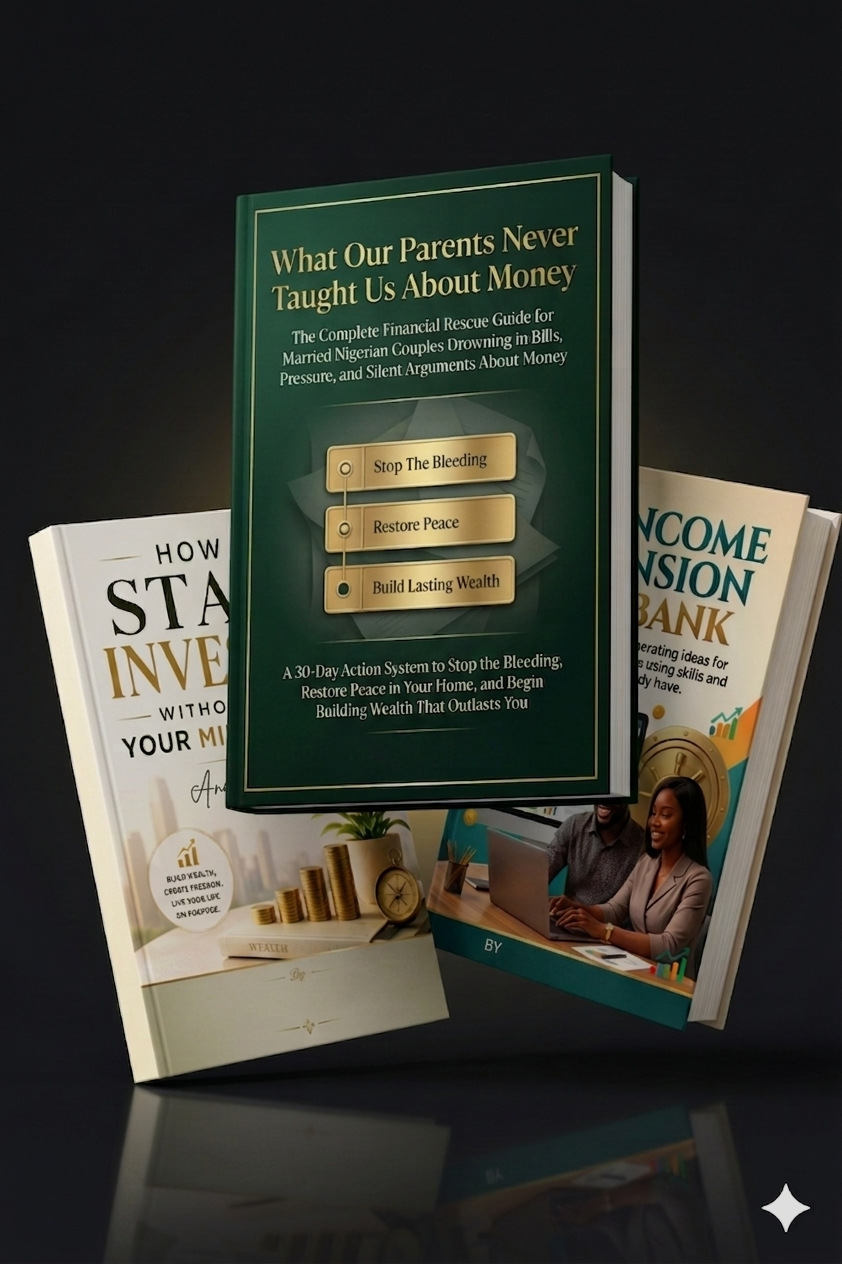
Total Value of Everything You Receive:
₦27,500 → Only ₦9,800 Today
🔥 Click Here To Get the Full Guide + All Bonuses NOW — Only ₦9,800!
⏰ First 50 buyers only at this price. Act before the offer closes.
📲 See What's Happening Right Now in Our Buyers' Group...
💰
WOPNTTUA Buyers ✅
147 members | 23 online
⚠️ 37 people have already taken advantage of this discount...
Only 13 spots remaining at the ₦9,800 price before it goes back to ₦15,000.
And bear in mind — you are not the only one viewing this page right now.
⚡ Yes! I Want In — Get My Copy + Bonuses Now
Secure checkout. Instant download. 30-day money-back guarantee.
My Bold, Risk-Free Promise To You
Still feeling unsure? I totally understand. Which is why I'm making you a bold, risk-free promise:
Try the full guide for 30 days. Complete the Money Truth Audit with your spouse. Follow the 30-Day Action Tracker. Use the Conversation Script. Do the work.
If — after 30 days of genuinely following the system — you do not feel that your financial clarity has improved, that arguments about money have reduced, and that you are both finally moving in the same direction... I will refund every naira. No questions asked. No long explanations required.
The only thing you have to lose is the financial pressure that has been sitting on your marriage. And something tells me you are more than ready to lose that.
💬 More Real Stories From Real Couples
SU
Sunday & Uche Eze
I want to be very honest. Before I bought this guide, I thought our problem was that we don't earn enough. The audit sheet showed us we earn enough — we just bleed too much. We found ₦52,000 in monthly leaks. Fifty-two thousand naira. Every month! Just disappearing into habits we never questioned. Week three we channeled that ₦52,000 into a savings account. First time in our marriage we have ended a month with something left. I keep shaking my head at what we were losing all this time. Please buy this. Don't think. Just buy it.
★★★★★
RB
Rotimi & Bukola Adeleke
My wife bought this without telling me. She just left the PDF open on the dining table one Saturday morning and said "read from page one." I sha sat down and started reading. I didn't get up for two hours. By afternoon we were doing the audit together. I am a stubborn man — my wife will confirm this. But even I couldn't argue with the numbers when they were there in black and white in front of both of us. This guide doesn't lecture you. It shows you. And once you see it, you cannot unsee it. We are now on day 26. Peace has returned to this house. Real peace. E no be small thing.
★★★★★
AO
Amaka Obi-Nwosu
My husband was the one spending carelessly. I don't want to lie. I was too afraid to bring it up because every time I did, we fought. The Conversation Script on page 22 gave me the exact words to say — gentle but clear. I used it word for word. He didn't get defensive. For the first time in five years, he listened. We finished that conversation and he said "Amaka, I didn't realise." That moment alone was worth ₦9,800. The rest of the guide is a bonus on top of that. I am crying as I type this because I spent so many years afraid to talk about money in my own home. Thank you for this work.
★★★★★
JM
Jerome & Miriam Nwosu
We are here in London and I was honestly not sure this would apply to us. But our situation is the same — different currency, same pressure. Family back home expecting support. Two children. Rent that never sleeps. And money conversations that always ended badly. We adapted the budget template to pounds and it worked perfectly. The psychology behind the guide — the audit, the script, the tracker — that part is universal. Day 18 and we've had zero money arguments. Zero. That has never happened in our six years of marriage. I recommended this to three other Nigerian couples in our church here. All three have thanked me.
★★★★★
FA
Fatima & Ahmed Suleiman
I want to speak to the husbands specifically. You feel like the pressure is on you alone and you are failing. That is what I felt. I bought this guide at 11pm on a Tuesday when I couldn't sleep because I was worried about money again. By 1am I had completed the audit and called my wife to come and see. She was surprised I was the one initiating a money conversation. We sat there at 1am going through our numbers together for the first time. By 2am we had a plan. A real plan. I slept that night better than I had in months. Brothers — don't let pride stop you. Get this guide. Your wife is waiting for you to lead. Lead.
★★★★★
You Now Have Two Choices...
✅ Option 1 — Take Action Today
Get the complete guide. Do the Money Truth Audit tonight with your spouse. Use the Conversation Script. Follow the 30-Day Tracker. Stop the bleeding. Restore the peace in your home. Begin — for the first time — building wealth that outlasts you. Give your children the future you always promised them. All for ₦9,800, backed by a 30-day money-back guarantee. Zero risk.
❌ Option 2 — Close This Page
Go back to the same cycle. Same end-of-month panic. Same arguments about money. Same "this month will be different" that never turns into different. Keep watching American YouTube finance videos that don't apply to your situation. Keep trying side hustles that don't scale. Keep recycling the same small money in ajo groups. Maybe things will sort themselves out. Maybe. But deep down, you already know they won't — not without a real system and a real change.
Maybe God led you to this page for a reason. Only you can decide what to do with it.
⏰ The clock is ticking. The first 50 spots are running out.
🚀 YES! I'm Ready — Give Me the Guide + Both FREE Bonuses for Just ₦9,800
💳 Card | Bank Transfer | USSD | Instant Download | 30-Day Money-Back Guarantee
🔒 Your payment is 100% secure. Processed by Selar.
Questions? Contact us at: tonedomacademy@gmail.com
God bless the day I saw this. Honestly I was very skeptical — I said "another one of these things." But my wife forced me to buy it and I bless her every day for that. We did the Money Truth Audit on a Sunday night and I almost fell off my chair. We were leaking ₦34,000 every month. Every month! And we didn't even know. We thought we were just not earning enough. No — we were earning enough, we just had holes everywhere. One week after plugging those leaks, we already had savings for the first time in two years. Two years! This guide is the real deal. Not motivational — practical. Buy it now.